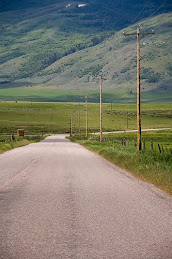
My passions in life include my faith in God, my family, American history, and a good road trip.

Click here for the scoop on why there is no Interstate 50.

Monday, July 27, 2009

Meeting the neighbors

Our daughter who lives in Georgia is in the process of moving to a new apartment, one that is far closer to where her husband goes to pharmacy school. I think she would not mind my sharing this post from her private blog:

Our new neighbor Terry came over to introduce herself and this was how our conversation began . . .

Terry: "Are you Roman Catholic because you have a lot of children?"

Me: "Actually I'm a member of The Church of Jesus Christ of Latter-Day Saints."

Terry: Blank stare

Me: "Sometimes people call us 'Mormons.'"

Terry: "Oooh, so does your husband have more than one wife?"

Me: "Nope, he's stuck with just me."

Did we mention that our daughter and her husband have two children? Apparently in some circles that is "a lot of children."

Saturday, July 25, 2009

Change of address

Keith J. Beazer used to live in the house we now live in. He moved four years before we bought the home. And we have lived here going on 32 years.

Periodically, a couple times a year, we still get mail addressed to him at our address. Always from the Metropolitan Life Insurance Company. Because they've had to do with insurance, I always hand delivered the unopened envelopes to his married daughter who works at the same place I do. I naively assumed that the family at some point would change the address or otherwise put a stop to the letters coming our way.

Another one came today, a postcard notifying Keith of a class action suit for something that occurred in the year 2000. Did I happen to mention that Keith Beazer died something like 20 years ago? Or more?

And his life insurance company doesn't even seem to know about it. Scary.

Monday, July 20, 2009

One small step for a man


Forty years ago today—on July 20, 1969—man first stepped onto the moon.

Three astronauts were a part of the Apollo 11 mission to the moon: Neil Armstrong, Buzz Aldrin, and Michael Collins. Armstrong was the first to set foot on the moon. Aldrin was second. As Armstrong stepped onto the surface of the moon, he uttered the words, "That's one small step for man, one giant leap for mankind." After a couple hours on the lunar surface, the two rejoined their third companion, who had been orbiting above in the spacecraft. And then they returned home to earth.

It had been a mere 66 years since Orville Wright flew the first powered airplane at a wind-swept beach at Kitty Hawk, North Carolina, on December 17, 1903. The first flight lasted only 12 seconds and covered 120 feet. Three more flights were made that day with Orville's brother Wilbur piloting a flight that lasted 59 seconds and covered 852 feet. Americans consider the Wright brothers the fathers of aviation.

Brazilians, those dear people among whom I served my mission, consider one of their own countrymen as the father of aviation. Santos Dumont [Alberto Santos Dumont, 1873–1932, born in the Brazilian state of Minas Gerais] designed, built, and flew the first controllable airship, a small blimp, around the Eiffel Tower in Paris on October 19, 1901. Five years later, on October 23, 1906, he flew a fixed-wing airplane, the first such aircraft to be publicly witnessed to take off, fly, and land in Europe. He was one of the most famous people in the world in the early years of the twentieth century.

Even though he died in 1932, he was still very famous and very revered in Brazil when I was there serving my mission in 1969 and 1970. The smaller of two airports in Rio de Janeiro was named after him, and while I was serving in the mission office I went there at least once to meet someone flying in from São Paulo. Arriving and departing missionaries flew into and out of the larger, newer Galeão International Airport. The smaller, older Santos Dumont Airport primarily handled domestic flights to and from other Brazilian cities.

And so I guess it was appropriate that I was in Brazil for one of the most significant events in the history of mankind: man's first steps on the moon. And although the Apollo 11 spacecraft actually reached the moon on my 20th birthday, Saturday, July 19, 1969, the space module Eagle did not actually land on the surface of the moon until what in the western hemisphere of our planet was Sunday, July 20. But that seemed appropriate: July 20 was the 96th anniversary of Santos Dumont's birth.

"A dream of ages was fulfilled tonight," I wrote in my missionary journal for Sunday, July 20, 1969, "as man stepped onto the moon. Ever since the project was given the final go-ahead a few days ago, I have prayed for the mission's success and for the safety of the astronauts. But the moon is no longer virgin soil. The two Americans stepped onto the moon just a few moments before midnight Brazilian time, about 40 minutes after we gave up the vigil and went to bed. Probably every television set in the world was tuned to the coverage of the moon shot. Part of the goal set back in 1961 by John F. Kennedy has been realized: having a man on the moon before 1970. The other part? To bring them safely back to earth."

The next day, Monday, July 21, I wrote in a letter to my family back home in Idaho: "Yesterday, July 20, man first stepped onto the moon. A dream of centuries has been realized within 66 years after man’s first heavier-than-air flight at Kitty Hawk on that Dec­ember morning in 1903. In just a lifetime fantasy has become reality. What will that many more years bring? We are living in an exciting age, in adventurous times."

It was a heady time. For days afterward we missionaries, being Americans, were hailed on the streets as heroes, as though we had played some personal part in the historic drama that played out before the eyes of all the world.

On Thursday, July 24, which was being celebrated back home as Pioneer Day, I made one final journal entry: "Appropriately America's modern pioneers, the three astronauts, safely returned from their journey to the moon. Although they went into incubation confinement immediately after leaving the space cap­sule, President Richard M. Nixon was aboard the naval carrier that picked them up to give them an appropriate heroes welcome."

Sunday, July 19, 2009

I am 60 years old

Today I am 60 years old. It has been an incredible journey. Who would have thought a farm boy from Idaho would have witnessed such remarkable changes, participated in such historic events, and associated with such wonderful people all along the way? Hopefully I have made some useful contributions to the world during the six decades I have been here.

Gordon B. Hinckley (1910–2008), one of the wisest men I have ever known and with whom my life intersected a few times, said many years ago: "Anyone who imagines that bliss is normal is going to waste a lot of time running around shouting that he's been robbed. The fact is that most putts don't drop. Most beef is tough. . . . Life is like an old-time rail journey—delays, sidetracks, smoke, dust, cinders, and jolts, interspersed only occasionally by beautiful vistas and thrilling bursts of speed. The trick is to thank the Lord for letting you have the ride" (from a BYU devotional address in December 1973).

That rings true to me. Throughout life's journey I have loved and been loved, I have known both joy and sorrow, I have enjoyed both health and sickness, I have had a reasonable share of life's ups and downs.

I also like what his wife, Marjorie Pay Hinckley (1911–2004), once said: "The only way to get through life is to laugh your way through it. You either have to laugh or cry. I prefer to laugh. Crying gives me a headache."

Good counsel indeed.

And, above all, I have tasted of the sweet fruits of the Lord's Spirit. I have basked in God's love. I have had glimpses of the glories that await if I remain true and faithful all the remaining days of my life, however many or few they may be.

America's choir


Eighty years ago—on July 15, 1929—the Mormon Tabernacle Choir began broadcasting a weekly radio program, "Music and the Spoken Word," that continues to this day, making it the longest running live broadcast in history. Today, nearly 4,200 broadcasts later, the weekly program is carried on more than 2,000 radio, television, cable and satellite stations, as well as on the Internet. This morning the choir is celebrating its 80th birthday and officially launches its ninth decade of broadcasting.

Technology has changed dramatically during the eight decades since that first July broadcast. The first network radio broadcast featured a single microphone hanging from the ceiling of the Salt Lake Tabernacle. An engineer received his starting "on air" signal by telegraph. And the announcer perched on top of a ladder during the half-hour program to speak into the hanging mike.

Dating from August 1847, just one month after the Mormon pioneers first entered the Salt Lake Valley, the choir is one of the largest and oldest choirs in the world. It has performed before at least ten U.S. presidents, won scores of awards, sold millions of records, and sung before delighted audiences in many countries, including taking part in the opening ceremonies of the 2002 Winter Olympics. The choir's annual Christmas concert, taped each Christmas season and shown the following year during the holidays, is one of the most-watched broadcasts on PBS television stations across the country. President Ronald Regan (1911–2004) dubbed the choir "America's Choir" when it sang at his first presidential inauguration in 1981.


I have long admired the Tabernacle Choir. Though many years have passed, I still have vivid memories of the first time I heard the choir in person. It was Easter Sunday in April 1966. I was 16 years old. An older brother and I had traveled from Idaho to Utah for the annual conference of The Church of Jesus Christ of Latter-day Saints.

At the closing session of the conference that afternoon, David O. McKay (1873–1970), who was the ninth president of the Church, delivered his own final address and left his blessing upon the Church. He was advanced in age, and it proved to be the last sermon he ever personally gave in a general conference. We loved and sustained him as our prophet.

As he finished speaking, the mighty organ and choir joined together in "The Hallelujah Chorus" from Handel's Messiah. As is the tradition with this Easter anthem, the congre­ga­tion stood. After the last powerful strains had filled the air, the choir softly and reverently intoned President McKay's favorite hymn:

I need thee every hour,
Most gracious Lord;
No tender voice like thine
Can peace afford.

I need thee;
O I need thee;
Every hour I need thee!
O bless me now, my Savior;
I come unto thee!

It was an electrifying moment. I doubt there was a dry eye or an untouched soul in the entire Tabernacle.

Saturday, July 18, 2009

I worked in the garden this morning

Along with a score of neighbors, I worked in the neighborhood garden this morning. I weeded one and a half rows of corn before going off to other commitments. The sun was up, and it was getting awfully warm before I finished. I was pretty sweaty. I was thinking we should have begun at six o'clock rather than eight.

"It was a lot easier to do this when I was 14," I said to my good wife after I came home. A bit later, in fact, I went to the gym to work out with my trainer and by then noticed I had used some muscles I was not used to using in my regular workouts.

Some of our neighbors have already been enjoying some of the fresh produce from the garden. The zucchinis are plentiful right now. The corn and beans and a variety of other vegetables are coming along.

We haven't been into gardening much over the years. Our focus has been on fruit trees, which tend to behave themselves and not get into too much mischief. We have four trees in our front yard: an apple, a cherry, a pear, and an apricot. This year birds ate most of the cherries, and the apricots are a lot thinner than in most years, probably because of the massive pruning of the tree early in the spring.

We pay neighbor boys to care for our lawn and flower gardens. Their mom grew up on a farm in northern Utah and wants her three sons to learn how to work. And to earn money for when they grow up and go away at their own expense to serve as Mormon missionaries. They still have a ways to go on learning how to work, but we're happy to contribute toward her goal. Last year they planted a row of green beans along our back fence. This year potatoes. In recent years that's pretty much been the extent of our vegetable gardening.

A retro gadget

I drive a 1998 Ford Ranger pickup. Going soon on twelve years old. It does have air conditioning, but otherwise nothing fancy. No power windows or door locks. Your basic model.

And, oh, did I mention it's entirely paid for?

A couple months ago I had a date with my oldest granddaughter. We call them nights out with Grandpa. She is twelve years old, and never before in her life had she ever ridden in my pickup. She was intrigued by the handle used to crank the window up or down. She had never seen such a thing. She was used to pushing a button to open or close a car window.

"This is a handy little gadget," she observed, as she cranked the handle to roll the window up. What will they think of next?

Friday, July 17, 2009

I love summer mornings

Early this morning, before the sun peered over the mountains to the east of us, I was waiting at the bus stop to catch my ride to work. It was a gorgeous day. Traffic along Orchard Drive, never busy at this time of day, seemed lighter than normal. Perhaps people were off on summer vacations.

A jogger happened by. He was running in the street, reverting to the sidewalk only when an occasional car approached, and then he was back into the street. We exchanged good mornings.

The temperatures were pleasant, the morning quiet, and I was in a relective mood.

I thought of the words of the Lord recorded by the prophet Isaiah in the Old Testament: "I have made the earth, and created man upon it" (Isaiah 45:12). It is a remarkable place God has prepared for us. And yes, there is much of ugliness and misery across the face of the earth, far too much of it in fact, but the earth itself is a remarkably diverse and interesting and beautiful home for His children.

And then this further insight from the prophet Nephi in the Book of Mormon: "Behold, the Lord hath created the earth that is should be inhabited; and he hath created his children that they should possess it" (1 Nephi 17:36).

Just earlier in the week I had read of extreme environmentalists who share the notion that the earth would be better off if humans were not around, if people did not inhabit the planet. Or others, not going quite that far, urging that humans are simply one species among all the other life forms on our little globe and that we deserve no particular status or consideration beyond the whales or snails or whatever is the cause de jour.

Now don't start plastering me with comments about the environment. I firmly believe we should be good stewards of planet earth. I believe we need to be responsible citizens of the world. We need to treat our home with respect. But I view the world from a perspective of faith, seeing "with an eye of faith," to borrow an insightful phrase used throughout the Book of Mormon (see, for example, Alma 5:15; Alma 32:40; Ether 12:19). And that perspective is that there is a God, that He created the world, that He placed His children upon it, and that it exists for them to inhabit it. That's what it's all about.

When we don't see it that way, we get it all backward and screw up our public discourse and our public policy in horrible ways that can lead to no good.

And so, I guess that's why we need summer mornings. Outside and quiet and alone. Not in our homes or cars. And not with televisions or radio or iPods blaring in our ears. We occasionally need time and circumstances to be reminded of the truth penned by the poet Elizabeth Barrett Browning (1806–1861):

Earth's crammed with heaven,
And every common bush afire with God;
But only he who sees, takes off his shoes—
The rest sit round it and pluck blackberries.

Thursday, July 16, 2009

Marriage and divorce

This is worth watching.

Wednesday, July 15, 2009

A trip to Washington

Thursday, July 2, 2009
Utah, Idaho

At 11:00 I left in our pickup and drove the the 100 miles to Rachael's house in Malad. Robert was there and had someone there preparing an estimate on moving them at the end of the month to Illinois. After he left and Robert returned to the hospital, Rachael finished getting ready and packed her minivan while I kept track of little Margaret.

At 1:15, after asking a blessing on our trip, we left Malad, heading north on I-15 to Pocatello, west on I-86 and then I-84 to Nampa. We reached Boise at 5:15 and about half an hour later Dale and LeAnn's house in Nampa. Other than the persistent "Are we there yet?" the girls were reasonable travelers for a six-year-old, a four-year-old, and a 21-month-old.

Dale had arranged the Idaho family to get together to see us: Lyle and a lady friend named Doris, Jackie and Jared, and Cheryl and four of her children (LaWanda and her husband Terry, Bobbie, Gena, and Ronnie and his baby Roxie). Gene was up in the mountains working on their cabin. There were 17 of us who went out to eat at a Mexican restaurant. Dale told the server that we were celebrating my birthday, so at the end of the meal she brought me a free dessert (fried ice cream), and the workers and other patrons sang "Happy Birthday" to me.

We returned home to Dale and LeAnn's house, and everyone else left except Jackie and Jared, and we played six rounds of a card game called Skip Bo, then went to bed.

Friday, July 3
Idaho, Oregon, Washington

LeAnn fixed us breakfast, and we ate, packed, and hit the road a little after 9:00. Kind of. We actually drove around the Nampa area to take pictures of where I went to high school, the farm house we lived in 50 years ago when my family first moved to Idaho, Scism School (where I attended fourth, fifth, and sixth grades), and the final house we lived in on Ventura Drive. We then drove through downtown Nampa and got on the freeway but exited a few exits later toward Greenleaf, Roswell, and Adrian. We saw the farm where I lived the first decade of my life, the school I attended in Adrian, the Owyhee Ward building, and the stake center in Nyssa where I was baptized. We drove past Ontario, where I was born, and got on I-84 again and headed west.

It was the first time Claudia, Esther, and Margaret had been to Oregon.

We stopped two or three times at rest stops, traveled through the beautiful Blue Mountains, and stopped in Pendleton for gas and lunch. We ate at a local restaurant called Roosters. While at the restaurant we talked on the phone to Camilla and to Mom, then the battery died on my phone. Rachael's battery also died. We were traveling just like in the olden days without any contact with the rest of the world.

We left I-84 and took I-82 crossing the Columba River at Umatilla, and headed north and west through Washington until we joined I-90 and headed due west. It was the first time the girls had been to Washington.

We did a few more rest stops before leaving the Cascades and coming into the Seattle area. We headed north on I-405 and then I-5 to Everett. We wondered how we'd contact Chris and Camilla to get into their apartment complex, but we saw their bakery was still open and stopped there. I had forgotten that during the summer they extended their store hours from 6:00 to 8:00 in the evening. Chris, Camilla, and Sam were there and fed us sandwiches for dinner as they were getting ready to close their store at 8:00. We, the girls especially, were glad to be through traveling. After closing the store, we went over to the apartment and then Chris took Rachael to the motel on Evergreen Way that she and the girls are staying at. I stayed with Chris, Camilla, and Sam.

Saturday, July 4
Washington

Today is the birthday of our country. Late this morning Camilla, Sam, Rachael, Claudia Sue, Esther, Margaret, and I went to the Everett Station and took a free shuttle bus from there to watch an 11:00 Fourth of July parade. Chris isn't much into parades and stayed home. The parade was much more diverse, ethnically and otherwise, than we might have seen in Utah. I don't think we'll anytime soon see belly dancers, for example, in the Handcart Days parade. At the end of the parade, as we were walking back to catch our shuttle, I bought ice cream for the children. We returned to the apartment, ate lunch, and rested.

This afternoon Camilla took all of us but Chris and Margaret, who was still sleeping, to a beach on the Puget Sound. We went through a beautiful, dense forest to get to it. The tide was in so there was actually not much beach, but the children all had fun playing in the surf. It was the first time Claudia and Esther had seen the ocean. They collected a number of seashells.

Chris had dinner nearly ready when we returned, and Margaret had just awakened a bit before.

In the evening we drove to Lake Stephens to watch fireworks. The light of a nearly full moon shimmering across the lake presented a picturesque setting, and fireworks were being set off all around the lake for the more than an hour and a half we were there. It was impressive, something like watching twenty different fireworks displays all at once. I had never seen anything quite like it.

Sunday, July 5
Washington

This morning, beginning at 10:50, we attended church in the Mukilteo Ward. Sunday School was first, followed by a combined priesthood/Relief Society opening exercises of the two wards that share the building (something to do, they explained, with a part of the building being remodeled), followed by Chris going to elders quorum, Rachael to Relief Society, and me to high priests group. We then concluded with fast and testimony meeting.

We returned to Chris and Camilla's to visit, nap, play games, and such. Late in the afternoon all of us but Chris and sleeping Margaret went on a walk around the neighborhood and ended by dropping by the bakery (what Sam calls "Daddy's work") to pick up some mayonnaise for dinner and chocolate chips to make cookies afterward. After dinner Claudia and Esther helped clean up the kitchen and table and load the dishwasher so they could help Chris make chocolate chip cookies. After playing games, Rachael and the girls returned to their motel.

Monday, July 6
Washington

Around noon Chris took Rachael, Claudia Sue, Esther, Margaret, Sam, and me to the Forest Park petting zoo. The children enjoyed the animals. It was an overcast day and tried raining on us a couple times. In the evening Camilla took Rachael and her girls swimming in an indoor swimming pool in another apartment complex owned by the same company as hers. I went along to take pictures with Rachael's camera. The water was cold, but everyone had fun.

Tuesday, July 7
Washington

We took the children to a free movie at the mall, Kung Fu Panda. Rachael bought us popcorn. I made arrangements to go visit Dana Blackham and his wife Wednesday evening in their home in Edmonds. Dane and I had been missionary companions in Brazil, roommates back at BYU, and he was the bestman at our wedding. His wife Linda had died some years ago, and he married Becky, much to the opposition of his children and family. It has been many years since we have seen each other.

In the afternoon Rachael and I took the children on a drive to Snoqualmie Falls. We took a scenic route to get there (along U.S. 2 and state highways 202 and 203), and the children all fell asleep. The falls were very impressive. We bought ice cream to eat, and Rachael bought Robert a hat and a very expensive $42 T-shirt. She did not know how much it would cost until after it was rung up by the cashier. We took a different scenic route back to Everett. Washington is certainly a beautiful place.

It was Vince's birthday back in Utah. This evening we called to wish him a happy birthday and got only his answering machine, so we all sang a voice message to him.

We then bought sandwiches at Chris and Camilla's bakery and had a picnic at the park by Silver Lake. After eating and playing on the playground equipment, we fed ducks in the lake.

Wednesday, July 8
Washington

I left around 7:00 to drive to the airport to pick Claudia up. Her plane from Salt Lake City arrived earlier than scheduled, but I was still there in time to park and greet her as she came out of the gate area. It was good to have her join us.

We drove back to Everett and took the children to another free movie at the mall, The Tale of Despereaux. Rachael again bought us popcorn. Southwest Airlines is having a sale, and in the afternoon Claudia and I arranged a trip in September to go visit Paul, Eliza, Peter, and Aaron in Atlanta. Just after I had purchased the tickets, Claudia realized it would be right around the time when Anna's baby is due, and she was regretting our decision to go the weekend she had selected.

In the evening Claudia and I drove to Edmonds to have dinner with Dana and Becky Blackham. It was a wonderful evening catching up on twenty or so years of not being in touch. We did not return to Chris and Camilla's until midnight. Rachael, Camilla, and the children had gone bowling while we were gone.

Thursday, July 9
Washington

Camilla had the day off work, and she went with us to a free children's concert in the park at Silver Lake featuring a group called Recess Monkeys. We enjoyed that, and Rachael bought their DVD which Claudia Sue and Esther enjoyed watching over and over the whole rest of the week. We bought lunch from the bakery.

In the evening we drove out to Lake Stephens, where Chris and Camilla were participating in the farmer's market there and where a bluegrass concert was being held. We bought and ate our supper at the farmer's market. It was a delightful evening.

Friday, July 10
Washington

Claudia and I went to exercise at the Gold's Gym in Everett. Later Claudia, Rachael, and I took the children on a long car ride. We headed up I-5 past Mount Vernon and exited the freeway at Burlington and headed west on highway 20 toward Anacortes and Deception Pass, where we crossed a bridge onto the north end of Whidbey Island. It was very scenic, but all of the children were alseep at that point, so we didn't actually stop and get out of the car. We drove down the length of Whidbey Island and took a ferry from Clinton to Mukilteo.

We bought a late lunch at a Wendy's and returned to Chris and Camilla's apartment. Rachael took Claudia Sue and Esther to Mountlake Terrace to visit with one of her online mothers' group friends. Margaret was sick and stayed with the rest of us.

Claudia and I bought a loaf of Dakota bread from the bakery and took it as a thank-you gift to Dana and Becky Blackham. Becky had mentioned Wednesday night it was her favorite bread from Great Harvest.

Saturday, July 11
Washington

Sam's third birthday. Before Sam woke up and before Rachael and her girls came over, Claudia and I went to exercise at the Gold's Gym in Mukilteo. It was a much nicer facility. After breakfast Sam opened his presents, one of which was a little aquarium and a Beta fish that he named Bruce.

In the late morning and into the afternoon we went to Jettey Island. It is a small manmade island that is accessible only by a free passenger ferry. There are no roads on the island. We ate a picnic lunch while we were waiting for our turn to go on the ferry over to the island. The tide was way out as we played on the beach. We saw a lot of wind surfers. I counted over twenty at one point. Little Margaret seemed to have the most fun playing in the little puddles of water on the sandy beach. Claudia Sue and Sam took naps, and Esther rested but never actually fell asleep. Rachael's girls were feeling sick and had fevers by tonight.

Sunday, July 12
Washington, Oregon, Idaho

This morning Rachael, Claudia Sue, Esther, Margaret, and I left for home. This was likely the last time Rachael and Camilla will see each other for a very long time, unless they both happen to be visiting Utah at the same time. Chris and Camilla will probably not get to southern Illinois anytime soon, and Robert and Rachael will probably not visit western Washington anytime soon.
Claudia stayed for the rest of the day, went to church with Chris and Camilla, and caught an evening flight home to Salt Lake. Both she and Camilla reported that Sam was very sad when he got up and found that Grandpa and his cousins/friends were gone. (Throughout the week Sam had variously referred to Claudia Sue, Esther, and Margaret as his cousins and his new friends.) He had enjoyed the week immensely.

After asking a blessing on our return trip, we left Everett at 7:00 (8:00 Mountain time) and reached Malad about 9:40 in the evening. A long day of driving.

It rained on us as we crossed through the Cascade Mountains in Washington and again from about the Oregon-Idaho border until past Boise, where it came down very hard. We were buffeted by strong winds all across eastern Oregon. We saw rainbows—always a good omen—as we drove across southern Idaho approaching Pocatello. We had stopped for lunch at a beautiful rest stop in the Blue Mountains and took breaks at a couple of rest stops elsewhere along the way. The girls were good travelers. Because they were sick, they slept a lot of the way. We didn't hear a single "Are we there yet?" until we were half way across the state of Idaho.

It was late enough when we reached Malad that I decided to spend the night rather than driving alone the remaining hour and a half back to Bountiful.

We had been recording license plates throughout our trip and had seen cars from 39 states and 5 Canadian provinces during the 1,700-plus miles we had driven from Malad up into the Pacific Northwest. (According to Google Maps, it is 813 miles from Rachael's house in Malad to Camilla's house in Everett.)

Monday, July 13
Idaho, Utah

This morning, after Rachael fixed me some breakfast, I left her house about 9:30 and reached Bountiful at 11:00, the same hour I had left Bountiful eleven days earlier to begin the trip.

Monday, June 15, 2009

The birth of our sixth child

In honor of Camilla's 28th birthday, we share this account of her birth those nearly three decades ago. Happy birthday, Camilla.

On Wednesday, January 7, 1981, I wrote in my journal, "Claudia finished reading Camilla, the biography of Sister Kimball, which we received as a Christmas gift. I finished the book during the holidays while I was sick. If our new baby is a girl, we will probably name her Camilla."

We had actually made that decision a month earlier. During December Claudia and I had been at the Missionary Department Christmas dinner on the 26th Floor of the Church Office Building. President Spencer W. Kimball and his wife Camilla also attended, and we sat at the same table with them. Claudia was expecting our sixth child. She was about three months along, and we decided that evening if our baby was a boy we would name him Spencer and if a girl we would name her Camilla.

It would be another six months before we knew which one was coming.

Monday, June 15, 1981, was Claudia's parents' 32nd wedding anniversary. It was also three days after the due date of our sixth child. Early that day, about 3:30 in the morning, Claudia woke me up to say she was going to have a baby. Her contractions had started about 2:45, so she got up, washed two loads of clothes, showered, and washed her hair so she'd be ready to go to the hospital. We arrived there about 5:00, and Dr. Lewis delivered our sixth child and fourth daughter at 5:37. She weighed 8 pounds 8 ounces and was 21 inches long—our biggest baby thus far.

Dr. Lewis, who was leaving at 7:00 for a fishing trip in Alaska, said it was fortunate the delivery was fast. The baby was posterior, which made the very end of labor harder for Claudia. Also, because of the little one's position, the cord was pinched every time Claudia had a contraction. When Camilla was born, she was all purple and initially had a hard time getting her breathing started. Claudia was put on an IV before delivery but still bled heavily afterward. We were grateful for the blessings of modern medicine which the Lord has provided.

Claudia and Camilla were in the hospital until Thursday morning, June 18. I went to visit her early each morning, and the rest of the family came to see her and the baby each afternoon and evening. On one of those visits, six-year-old Rebecca gave Claudia a note:

I love you Mom. And Camilla. I like both of you. I think both of you are sweet. Here is a poem:

I like
Being in the hospital
With a babby.
The end.

Grandma and Grandpa Lange were in town visiting from California when Camilla was born. Grandpa and I were putting a new roof on our house.

The morning Camilla came home from Lakeview Hospital, all of the children were quite excited. We had a birthday party with gifts for each of the children: a soccer ball for Michael, roller skates for Rebecca, a dump truck for Talmage, and a doll for Anna.

Monday, June 08, 2009

Oh, what songs of the heart

This morning in our staff devotional I was assigned to give the spiritual thought. We sang the hymn "Oh, What Songs of the Heart" (Hymns [1985], no. 286), which was written by Joseph L. Townsend (1849–1942). I then gave a brief history of Brother Townsend's life, his conversion to the Church, a remarkable vision of the Savior he had after joining the Church, and quoted briefly from the nine other well-known hymns he wrote that are in our current hymnal:

"The Day Dawn Is Breaking" (52)
"Nearer, Dear Savior, to Thee (99)
"Reverently and Meekly Now" (185)
"Let Us Oft Speak Kind Words" (232)
"Choose the Right" (239)
"O Thou Rock of Our Salvation" (258)
"Hope of Israel" (259)
"Oh, Holy Words of Truth and Love" (271)
"The Iron Rod" (274)

And, of course, "Oh, What Songs of the Heart," which I want sung at my funeral. This is probably the least known of the ten hymns. I asked by a show of hands how many in our department devotional had known of the hymn before today, and fewer than half the hands went up. It is an upbeat, comforting testimony of what happens after we die:

Oh, what songs of the heart
We shall sing all the day,
When again we assemble at home,
When we meet ne'er to part
With the blest o'er the way,
There no more from our loved ones to roam!
When we meet ne'er to part,
Oh, what songs of the heart
We shall sing in our beautiful home.

Tho our rapture and bliss
There's no song can express,
We will shout, we will sing o'er and o'er,
As we greet with a kiss,
And with joy we carress
All our loved ones that passed on before;
As we greet with a kiss,
In our rapture and bliss,
All our loved ones that passed on before.

Oh, the visions we'll see
In that home of the blest,
There's no word, there's no thought can impart,
But our rapture will be
All the soul can attest,
In the heavenly songs of the heart;
But our rapture will be
In the vision we'll see
Best expressed in the songs of the heart.

Oh, what songs we'll employ!
Oh, what welcome we'll hear!
While our transports of love are complete,
As the heart swells with joy
In embraces most dear
When our heavenly parents we meet!
As the heart swells with joy,
Oh, what songs we'll employ,
When our heavenly parents we meet.

The hymn and the thought were timely. Just after our devotional we learned that the nineteen-year-old daughter of one of our coworkers had been killed earlier this morning in a car accident near Sugar City, Idaho. She was a student at BYU-Idaho.

Tuesday, June 02, 2009

The birth of our fourth child

In honor of Talmage's 32nd birthday, we share this account of his birth those three decades ago. Happy birthday, Talmage.

Talmage was born on Thursday, June 2, 1977. It was a beautiful sum­mer morning. Grandma and Grandpa Lange were visiting us from California. Grandpa had helped us build a brick-and-picket fence in front of our house in Rose Park to help keep nearly-two-year-old Rachael from wandering all over the neighbor­hood.

I was at work at the Church Office Building, and Claudia had gone to her doctor for her weekly visit. He thought she would be having a baby very soon.

Sometime between 10:00 and 10:30 that morning, she called me at work to say she was beginning to feel something, she thought. She was never sure about these things. I had the car and agreed to come home at lunchtime.

A little after 11:00 she called me again to say she thought I should come home right then. I excitedly hopped in the car and hurried home in less than ten minutes. No one was there.

The neigh­bor lady from across the street yelled that everyone had gone in Grandpa's car to the hospital in Bountiful. It was an exciting ride for the children as Grandpa slipped in and out of traffic trying to get to the hospital as quick as he could. Claudia was busy doing her panting exercise to try to keep something from hap­pening in the car.

When I got to Lakeview Hospital, probably not many minutes afterward, I went racing into the hospital, tearing down the hallway, when it occurred to me that I didn't have the fog­giest notion of where the delivery area was.

After helpful hospital people kindly directed me where to go, I scrubbed up and was coming into the delivery room through one door just as the doctor was entering through another. A nurse was pre­paring to deliver our baby and I guess would have done so had the doctor not arrived just in the nick.

In a special Christmas issue of the Cleverly Newsletter sent to non-family members in December, I recounted the official con­clusion of the story:

"Talmage John Cleverly was born at noon on Thursday, June 2, 1977, in the Lakeview Hospital in Bountiful, Utah—about forty minutes after Mama decided she was in labor, about ten minutes after she arrived at the hospital, about three minutes after the doctor reached the delivery room, and about a minute and a half after Daddy arrived from work. He was a healthy 3580 grams, 52 cm long, with lots of dark hair which is now a little lighter."

Talmage was our fourth child, our second son.

When I brought Claudia and Talmage home from the hos­pital on Sunday morning, there were Michael, Rebecca, and Rachael standing in the front yard to greet us. Rachael, of course, was on the outside of the closed new fence we had just built to keep her in.

Monday, May 18, 2009

And here we have Idaho again

A month ago I posted about my learning the Idaho state song in elementary school and singing it every time I enter the Gem State. I am not alone in that ritual. I was intrigued by this Family History Moment, written by Alaura Ramsey of Eagle, Idaho, on the back page of last weekend's Church News:

"My sister Debbie and I picked up my father from the airport. He was coming to town to attend his extended Mink family reunion. As he walked out the doors into the open air he began to sing loudly, 'And Here We Have Idaho!' It is the state song he learned in elementary school. I smiled. I turned my head, looked at him and thought, 'I love you.' . . . (Church News, May 16, 2009, 16).

Sunday, May 17, 2009

Brrrrr . . .

It's springtime. The temperatures are rising. The air-conditioner is on. And I'm freezing. Time to get out the sweaters and mittens.

Saturday, May 16, 2009

Ben makes front page of newspaper

Splashed across the front page of this morning's Deseret News [May 16] is a picture of Ben and his mom. It accompanies an article on online schooling.


The picture was taken by Kristin Murphy of the Deseret News. The caption read: "Ben Cleverly, 8, cuts out a drawing of a horse to make a jigsaw puzzle as his mom, Carisa Holden, watches in their Lehi home."

Monday, April 20, 2009

And here we have Idaho

I learned the Idaho state song during the spring of 1959. We had moved from Oregon to Idaho in the end of February, and I was a fourth grader at Scism School, a three-room country school south of Nampa. The fourth, fifth, and sixth grades were all in the same classroom with the same teacher. I learned the song in this classroom as we studied the history of Idaho.

And here we have Idaho
Winning her way to fame.
Silver and gold in the sunlight blaze,
And romance lies in her name.
Singing, we're singing of you,
Ah, proudly too,
All our lives through, we'll go
Singing, singing of you,
Singing of Idaho.

That is the chorus of the song. I never lived in the Gem State after I became an adult, but like a true Idahoan, I always sang the chorus as we crossed the state line into Idaho on various visits through the years. As I sang it, the words gradually morphed into this slightly alternative version:

And here we have Idaho
Wending her way to fame.
Silver and gold in the sunlit plain,
And romance lies in her name.
Singing, singing of you,
All proudly too,
All our lives through, we'll go
Singing, singing of you,
Singing of Idaho.

My family heard me sing my garbled version of the song enough times, almost as a rite of passage into the state, as it were, that some of them can sing some of the lines. I'm sorry that I taught them the wrong words.

I vaguely remember the lyrics of the first verse, although my singing the song as we entered the state did not include the verse:

You've heard of the wonders our land does possess,
Its beautiful valleys and hills,
The majestic forests where nature abounds,
We love every nook and rill.

I did not even remember, if ever I knew, that it had a second verse:

There's truly one state in this great land of ours
Where ideals can be realized.
The pioneers made it so for you and me,
A legacy we'll always prize.

Interestingly, I never learned the Oregon state song during the nearly four years of school I attended in the Beaver State.

Saturday, March 28, 2009

The great depression

Yesterday I finished reading The Forgotten Man: A New History of the Great Depression, by Amity Shlaes. The policies of the New Deal, which Franklin D. Roosevelt pursued throughout the 1930s, never did bring unemployment down or otherwise resolve the Great Depression, and yet it is scary to observe the parallels between what was tried and failed then and what is being proposed in our own time.

Several weeks earlier I finished reading FDR's Folly: How Roosevelt and His New Deal Prolonged the Great Depression, by Jim Powell. "In the minds of historians and the American public alike, Franklin Delano Roosevelt was one of our greatest presidents, not least because he supposedly saved America from the Great Depression," explains the back cover of the book. "But as historian Jim Powell reveals in this groundbreaking book, Roosevelt's New Deal policies actually prolonged and exacerbated the economic disaster, swelled the federal government, and prevented the country from turning around quickly."

"The next time economic cataclysm looms," wrote the National Review when this book was first published in 2003, "leaders should read Jim Powell's book." Well, the economic cataclysm is upon us again. I really hope President Obama and his advisers, along with our elected officials in Congress, have read the book. And heed its message. Or the days ahead could be nastier than they really need to be.

As George Santayana (1863-1952) wrote in 1905, more than a century ago: “Those who cannot remember the past are condemned to repeat it" (Life of Reason, Or The Phases of Human Progress: Introduction and Reason in Common Sense, 1:284).

Wednesday, March 18, 2009

Swimming

When I was a boy we lived within a mile of the Snake River, which curved to the south and west of our farm in a great bend that gave the area its name, Big Bend. We never went swimming in the river. Mama always warned us of its treacherous undertows and cur­rents. Plus I always secretly knew it had snakes swim­ming in it, and snakes and I respectfully kept our dis­tance, thank you.

We did swim, however, in a swim­ming hole a quarter or a half a mile south of the farm house. The swimming hole was at the junc­tion of a couple of drain ditches and had a culvert, a small, moss-covered cement thing, we used to slide down into the water, a welcomed relief on a hot summer afternoon. (I visited the spot after I was a grown-up and was utterly amazed at how much smaller it was than when I was little.)

At other times we would drive to a place called White Rock, located somewhere on the Owyhee River, a much smaller and evi­dently less treach­erous stream, since Mama let us swim there.

Some­time in the summer of 1955, just after I turned six, I nearly drowned at White Rock. (Mama mentioned in her diary our going to White Rock three times during the summer of 1955: July 23, July 25, and July 28. She did not mention my near-drowning, but she did record on July 28 that while up swimming she shut her little finger in the car door and "it sure hurt.")

Anyway, back to drowning. I was wad­ing along the side of the river in shallow water, stepping among the rocks that covered the bottom in the spot where I was. Some of my older bro­thers, swimming farther out in the stream, had seen some fish and were trying to catch them with their hands.

The next thing I remem­ber was standing or sitting on a rock that was slippery, with my body mostly under the water, when a fish splashed right in front of my face, just inches away. It startled me enough that I lost my balance, and I slipped out into the water, my head underwater, and I started drifting down­stream. I didn’t know how to swim, and I don’t think anyone had noticed me go under. It seemed like I floated along under­water for the longest time, as my brief little life passed by, although I was probably under only a few seconds.

As I floated by my brother Kay, who was thirteen, he saw my foot in the water. As he grabbed for it I remember his yell­ing something like, "Hey, here's that fish!" And he pulled a cough­ing, sputtering little brother foot first out of the water.

The whole experience scared me terribly. For years I had a great fear of any water I couldn’t see the bottom of, such as a lake or a river. A few years later, when I was a teenager, this fear kept me from earning the Eagle rank in Scouting. By the time I quit Scouting, I was only two merit badges short of Eagle—swimming and lifesaving.

By the summer of 1967, just after I graduated from high school, I finally worked up the courage to try water skiing for the first time. And I actually survived.

Tuesday, March 17, 2009

My earliest memory

Water is a part of my very earliest memory. We were out on a lake in a small motorboat. It started raining, and I must have been absolutely terrified. All I can remember is water. Water everywhere—water in the vast lake, water falling out of the gray sky, water spraying on me from the noisy motor. And, most likely, water streaming out of my bawling two-year-old eyes.


According to my mother's diary for July 1, 1951, we were with my grandparents on an outing at Jenny Lake in Wyoming's Teton National Park. That would have been two and a half weeks before I turned two.